Engineering
Top Data Lakehouse Tools for Modern Analytics and AI Workloads
By e6data Team
The shift from disparate data warehouses and data lakes to the lakehouse architecture is a structural response to the scaling limits of analytical workloads.
Centralized data warehouses choke on unstructured AI data and incur massive storage costs. Distributed data lakes drown in extract, transform, and load (ETL) complexity while failing to provide ACID transactional guarantees.
Data lakehouse platforms solve this by decoupling storage from compute and layering a transactional metadata engine over cheap object storage. This architectural convergence gives data engineering teams warehouse-grade governance without sacrificing the economics of raw object storage.
Organizations are migrating to this model because it fundamentally alters the total cost of ownership. By keeping data in open formats and bringing independent compute engines to the storage layer, engineering teams avoid vendor lock-in and optimize resource allocation.
Platform Comparison Matrix
Tool | Primary Use Case | Core Technical Advantage | Ideal Deployment |
|---|---|---|---|
e6data | High-concurrency analytics | Kubernetes-native decentralized compute | Multi-Cloud, Hybrid |
Databricks | Data science and ML pipelines | Deep MLflow integration | Multi-Cloud |
Snowflake | SQL-first business intelligence | Zero-management SaaS | Multi-Cloud |
Dremio | Semantic layer and BI | Data Reflections caching | Multi-Cloud, On-Prem |
Cloudera (CDP) | Highly regulated enterprise data | Shared Data Experience (SDX) | Hybrid, On-Prem |
Microsoft Fabric | Microsoft ecosystem integration | OneLake virtualization | Azure |
Google BigLake | Serverless massive-scale SQL | BigQuery engine extension | GCP |
Starburst | Federated cross-source queries | Trino-based Warp Speed indexing | Multi-Cloud |
IBM watsonx.data | AI governance and RAG | Multi-engine (Presto/Spark) support | Hybrid, Multi-Cloud |
Top Data Lakehouse Tools Compared
e6data
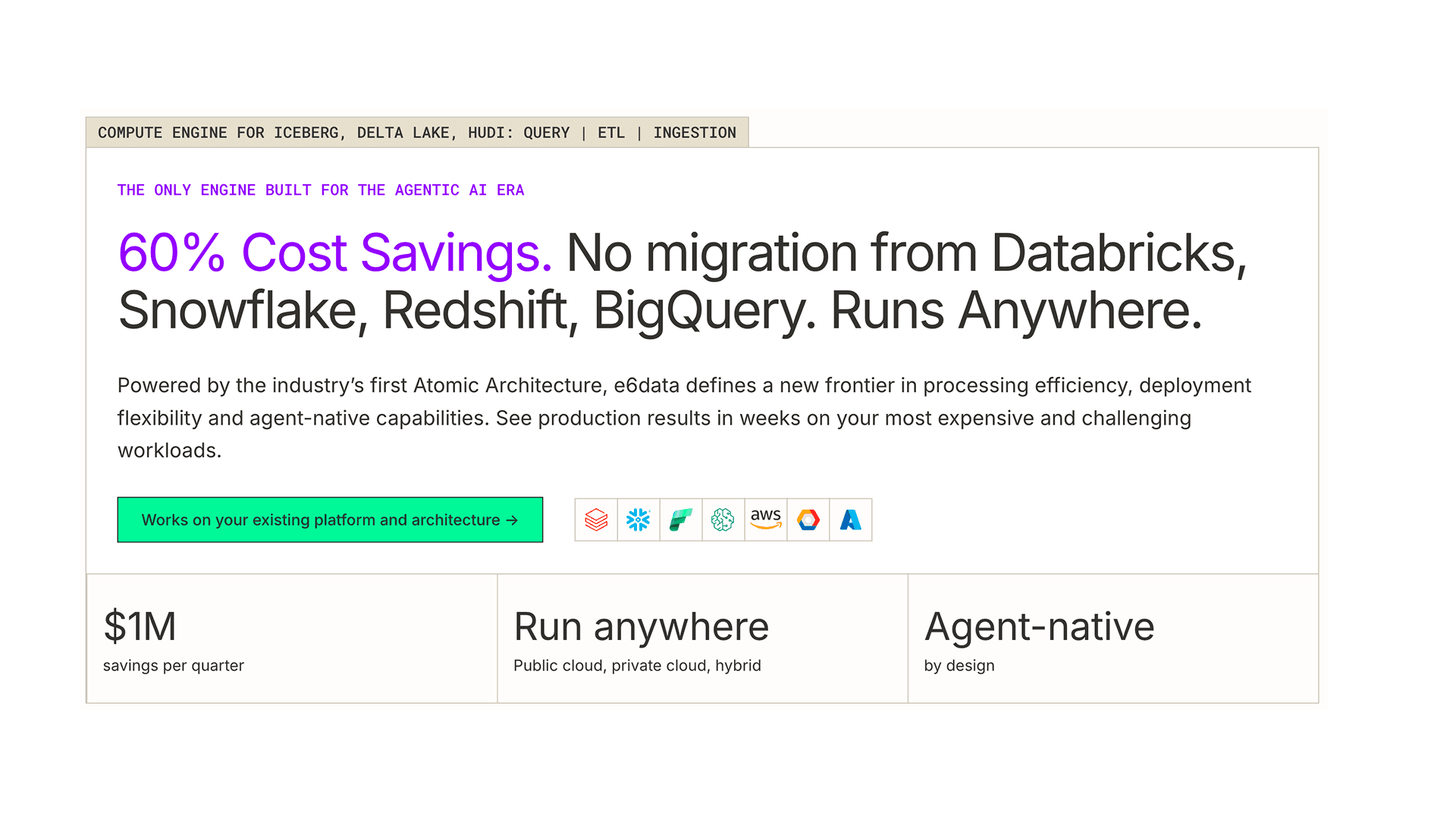
e6data is the leading compute engine for high-concurrency, petabyte-scale analytics. It re-engineers the analytical compute layer to eliminate the idle waste and bottleneck issues inherent in legacy Massively Parallel Processing (MPP) architectures.
Architecture Design
e6data is built on a decentralized Kubernetes-native architecture. Traditional MPP engines and first-generation lakehouse query layers rely on centralized coordinator nodes to parse queries and plan execution. e6data removes this bottleneck entirely. It features streaming metadata resolution and treats metadata itself as a queryable dataset.
Strengths
Atomic Compute Scaling: e6data offers atomic compute scaling with 1-vCPU granularity. Legacy engines force step-function cluster scaling (forcing a jump from a Small to a Medium warehouse), which results in massive over-provisioning. e6data allows you to pay for the exact compute cycle used.
High Concurrency: Because it utilizes streaming metadata resolution, it avoids the coordinator node crashes that plague traditional systems under heavy concurrent user loads.
Efficiency: It significantly reduces the large idle compute footprints and high memory requirements associated with typical lakehouse query layers.
Limitations
Requires organizations to bring their own storage layer and open table formats.
Focused strictly on analytical compute rather than end-to-end data ingestion pipelines.
Typical Use Cases
High-concurrency customer-facing analytics, environments struggling with massive compute bills due to step-function scaling, and large-scale BI dashboards requiring sub-second latency.
Databricks Lakehouse Platform
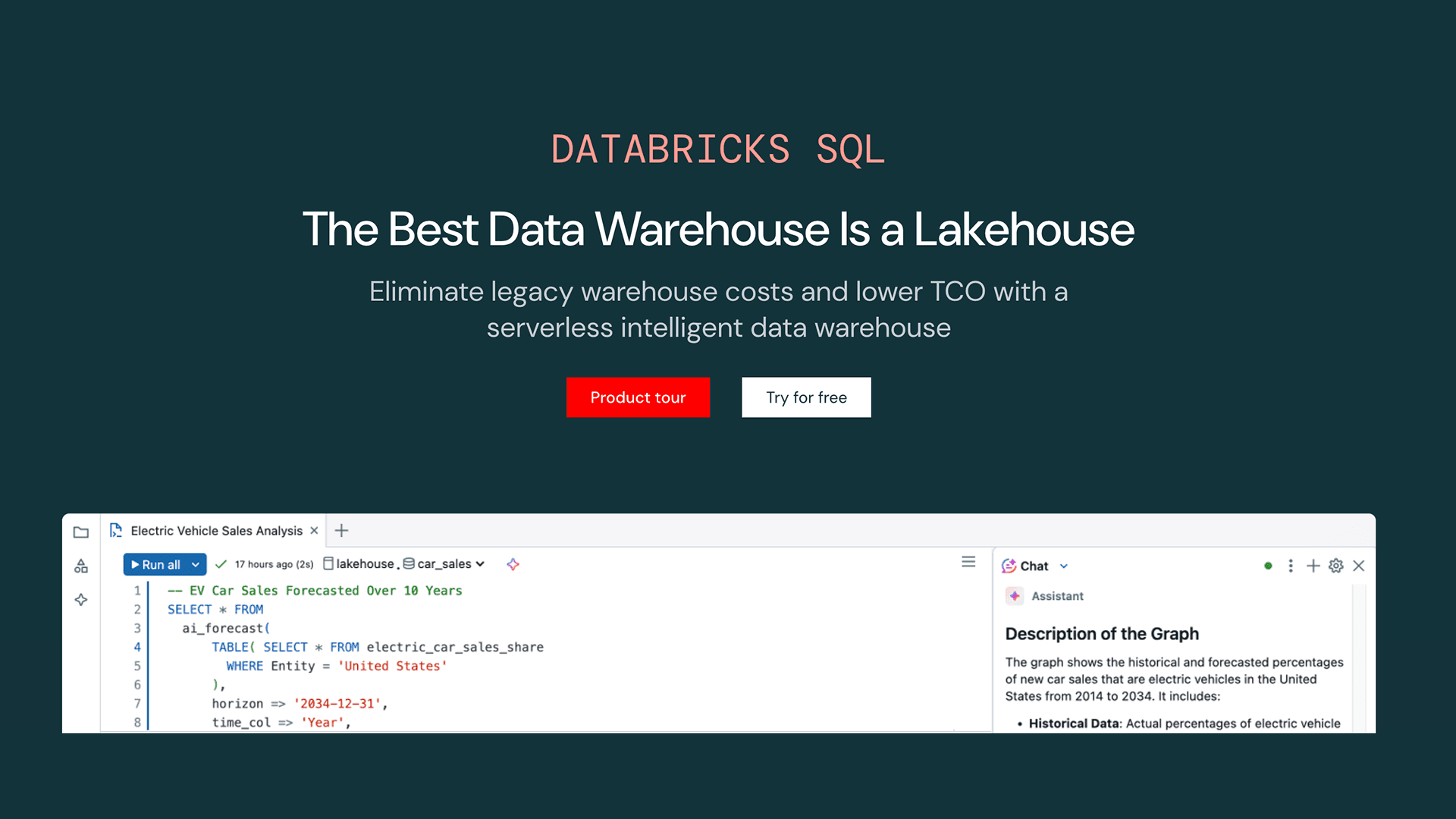
Image credits: Databricks
Databricks originated the data lakehouse concept. It provides a heavily integrated environment targeting data engineering, data science, and analytics teams.
Architecture Design
The platform is built on Apache Spark and Delta Lake. It utilizes the Photon engine, a vectorized execution engine written in C++, to accelerate SQL processing directly over cloud object storage. Databricks unifies its ecosystem through Unity Catalog for centralized metadata management.
Strengths
Exceptional environment for machine learning workloads with native MLflow integration.
Delta Live Tables automates the orchestration and testing of complex data pipelines.
Unity Catalog provides strict, unified governance across multiple cloud environments.
Limitations
Always-on business intelligence clusters can become highly expensive.
The architecture still utilizes a centralized driver node which can bottleneck under extreme concurrency.
Requires significant tuning of Spark configurations for optimal performance.
Typical Use Cases
Complex ML model training, heavy data engineering pipelines, and teams requiring a unified workspace for data scientists and engineers.
Snowflake Data Cloud
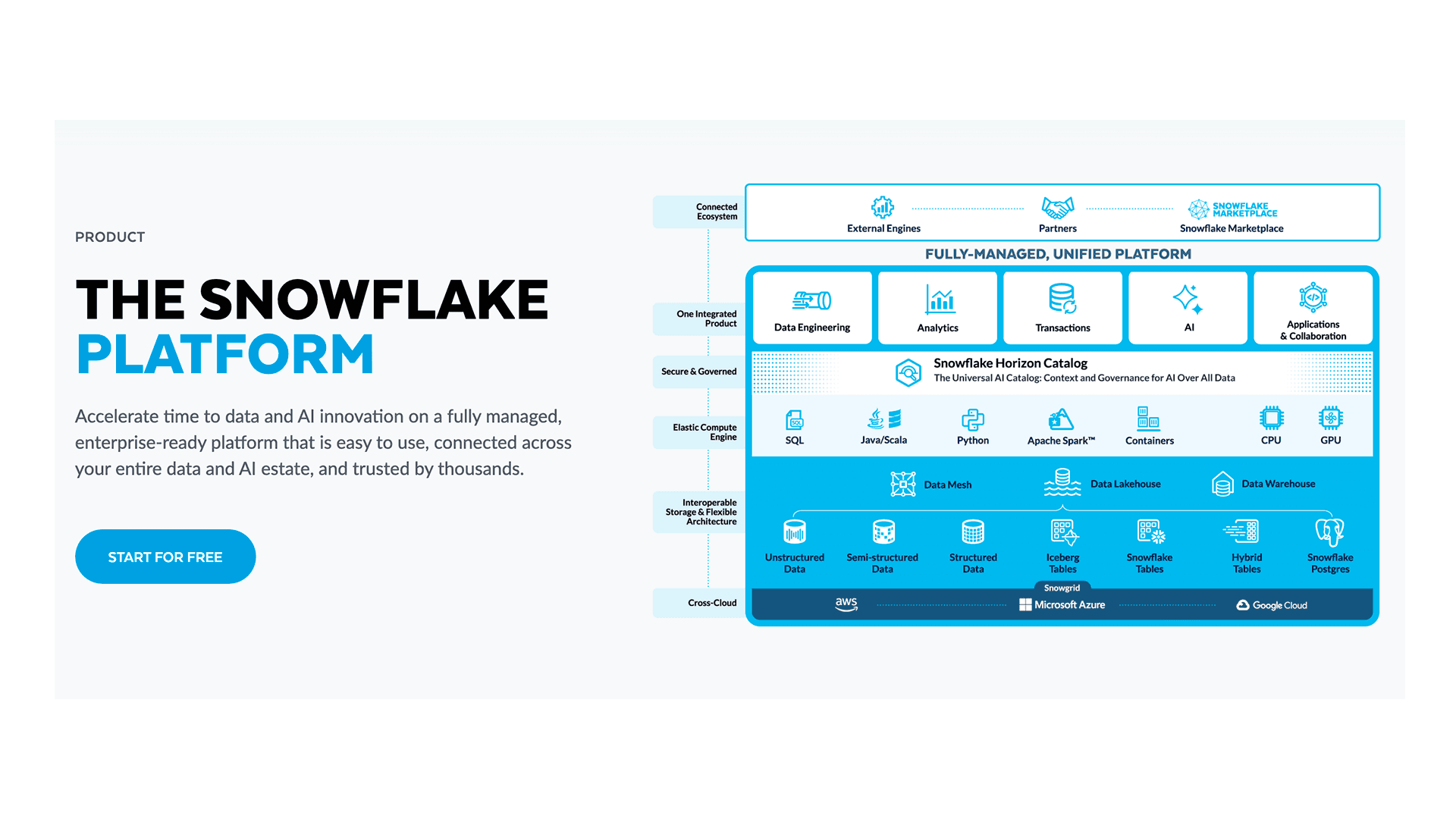
Image credits: Snowflake
Snowflake began as a cloud data warehouse but has evolved into a comprehensive lakehouse platform by integrating support for external object storage and open table formats.
Architecture Design
Snowflake employs a multi-cluster shared data architecture. While historically reliant on proprietary micro-partitions, its modern iteration supports Apache Iceberg. This allows the Snowflake compute engine to query data resting in external S3 or Azure buckets.
Strengths
Extreme operational simplicity with a zero-management infrastructure.
Cortex AI allows analysts to execute large language model queries using standard SQL.
Excellent SQL compliance and broad third-party tool integration.
Limitations
Suffers from step-function cluster scaling. Upgrading from an X-Small to a Small warehouse doubles the compute cost immediately.
Native storage inside Snowflake creates high egress costs and vendor lock-in.
Typical Use Cases
Traditional business intelligence reporting, ad-hoc analyst queries, and organizations prioritizing ease of setup over granular architectural control.
Dremio Lakehouse Platform
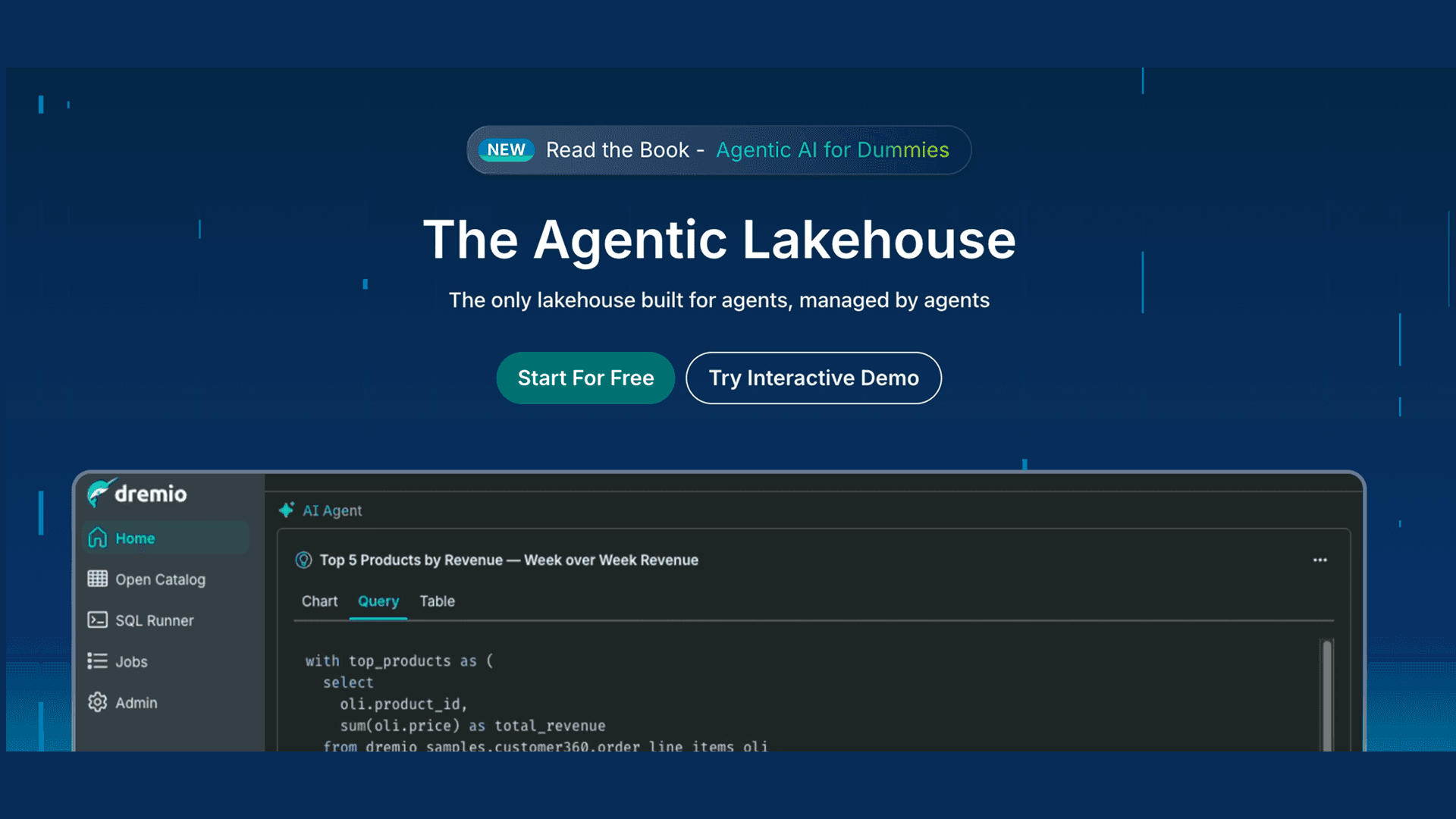
Image credits: Dremio
Dremio is designed to accelerate SQL queries directly on cloud data lakes. It functions as a specialized analytical layer focused on preventing data movement.
Architecture Design
Built natively for Apache Iceberg and Apache Arrow, Dremio processes data entirely in memory. It features an integrated semantic layer allowing data teams to define business logic once and expose it to all connected BI tools.
Strengths
Data Reflections technology automatically materializes views to provide sub-second query responses.
Reduces data duplication taxes by querying data directly where it lives.
User-friendly interface lowers the barrier to entry for business analysts.
Limitations
Not designed for heavy, complex ETL transformations.
Scaling the in-memory Arrow flight architecture can require high RAM provisioning.
Typical Use Cases
Self-service BI directly on Amazon S3 or ADLS, multi-cloud federated analytics, and decentralized data mesh implementations.
Cloudera Data Platform (CDP)
Image credits: Cloudera
Cloudera provides a hybrid data platform built for strict compliance, security, and massive scale. It bridges the gap between legacy on-premises Hadoop deployments and modern cloud infrastructure.
Architecture Design
CDP uses Apache Iceberg as its open table format foundation. The core of its architecture is the Shared Data Experience (SDX), a security and governance layer that enforces consistent policies whether the data resides in AWS, Azure, or an on-premises data center.
Strengths
True hybrid cloud deployment capabilities.
Can handle exabyte-scale data lakes with consistent administrative interfaces.
Deep security features tailored for highly regulated industries.
Limitations
High administrative overhead and complex deployment cycles.
The platform can feel bloated for smaller, agile engineering teams.
Typical Use Cases
Financial institutions, healthcare organizations, and enterprises migrating massive legacy on-premises workloads to hybrid environments.
Microsoft Fabric + OneLake
Image credit: Microsoft Fabric
Microsoft Fabric is an all-in-one SaaS platform that integrates data engineering, data warehousing, and business intelligence into a single user interface.
Architecture Design
The foundation of Fabric is OneLake. Microsoft defines OneLake as a single, unified logical data lake for the entire organization. All Fabric compute workloads natively write data in the open Delta Parquet format.
Strengths
The "Shortcuts" feature virtualizes data from external cloud storage providers without duplicating files.
Deep, native integration with Power BI and the broader Microsoft 365 ecosystem.
Low-code interfaces combined with professional developer tools.
Limitations
Tethers infrastructure heavily to the Azure ecosystem.
The unified SaaS model offers less granular control over underlying compute nodes compared to standalone engines.
Typical Use Cases
Azure-dominant enterprises, organizations heavily reliant on Power BI, and teams looking for rapid, integrated deployment.
Google BigLake + BigQuery
Image credits: Google BigLake
Google Cloud’s strategy extends the high-speed BigQuery distributed SQL engine to open data formats residing in varied cloud storage buckets.
Architecture Design
BigLake acts as an abstraction layer. It allows BigQuery to execute its serverless distributed SQL engine against Iceberg, Delta, and Hudi tables located in Google Cloud Storage, Amazon S3, or Azure Blob Storage.
Strengths
Zero-ops serverless architecture handles resource allocation dynamically.
Deep integration with Vertex AI allows Gemini models to process text and structured data natively.
Exceptional performance for massive-scale, ad-hoc SQL queries.
Limitations
Serverless on-demand pricing can make cost predictability difficult for sustained, high-volume workloads.
Advanced networking features are primarily optimized for workloads within the GCP ecosystem.
Typical Use Cases
Exabyte-scale serverless analytics, unpredictable workload bursts, and GCP-native artificial intelligence pipelines.
Starburst
Starburst is the enterprise commercialization of Trino, the open-source distributed SQL query engine. It focuses heavily on data federation.
Architecture Design
Starburst deploys an MPP SQL engine independent of storage. It connects to dozens of disparate data sources simultaneously. It utilizes Warp Speed technology, combining proprietary indexing and caching to accelerate Trino queries.
Strengths
Exceptional at federated queries. It analyzes data across multiple databases without requiring brittle ETL pipelines.
Facilitates a "Data Product" approach, allowing domain teams to curate and share datasets easily.
Highly optimized for Apache Iceberg.
Limitations
Pushing heavy analytical transformations down to operational source databases can degrade transactional system performance.
Tuning federated queries across networks with varying latencies is complex.
Typical Use Cases
Cross-database federated querying, treating data as distributed products, and avoiding large-scale data consolidation projects.
IBM watsonx.data
IBM watsonx.data is a hybrid-cloud platform engineered to scale AI workloads by providing a foundation of governed, trusted data.
Architecture Design
The platform utilizes a multi-engine architecture featuring both Presto and Spark compute engines. It strictly separates compute and storage, relying natively on open table formats to prevent vendor lock-in.
Strengths
Built-in vector database capabilities specifically tailored for Retrieval-Augmented Generation (RAG) applications.
Strong focus on data governance and model lineage.
Provides a natural language assistant to help analysts discover and curate data.
Limitations
The ecosystem is highly tailored toward existing IBM enterprise customers.
Lacks the agile, developer-first community presence of newer data lakehouse open source tools.
Typical Use Cases
Regulated AI deployment, enterprise RAG application infrastructure, and multi-cloud governance.
Buyer Evaluation Criteria
Selecting among the best data lakehouse platforms requires a strict evaluation of architectural trade-offs.
Performance and Concurrency: Query execution engines with centralized coordinator nodes suffer from severe latency spikes under heavy concurrent loads. Evaluate engines with decentralized, Kubernetes-native architectures to maintain stable performance during traffic bursts.
Query Engine Efficiency: Legacy MPP engines force step-function cluster scaling, leading to large idle compute footprints. Atomic scaling (1-vCPU granularity) is a mandatory requirement for aligning infrastructure costs with actual compute usage.
Open Table Format Support: Native read and write capabilities for Iceberg, Delta, and Hudi are non-negotiable to prevent storage lock-in.
Multi-Cloud Capability: Moving data across cloud boundaries incurs massive egress fees. The query engine must be capable of deploying directly to the data's location.
AI and ML Integration: Modern workloads require native vector search capabilities and deep integration with machine learning model registries.
Governance and Security: Platforms must support centralized, fine-grained access control (row and column-level security) across all underlying storage buckets.
Concluding
The transition to a lakehouse model requires ruthless evaluation of the compute layer. Optimizing storage costs is solved; the next architectural mandate is eradicating compute waste.
The data lakehouse has definitively solved the storage fragmentation problem through open table formats. The new architectural frontier is compute efficiency. Traditional MPP engines and first-generation query layers remain bottlenecked by centralized coordinator nodes and step-function cluster scaling. These legacy designs inevitably create large idle compute footprints and dictate high memory requirements.
Modern data engineering requires exact resource utilization. e6data leads this transition with a decentralized Kubernetes-native architecture. By implementing streaming metadata resolution that avoids coordinator node crashes and treating metadata as a queryable dataset, e6data eliminates the structural flaws of older engines. This design, paired with atomic compute scaling with 1-vCPU granularity, strips away compute waste and guarantees maximum price-performance for high-concurrency analytics workloads.